Platform Architecture & Technical Specifications

Engineered for rapid single-operator shallow-water access. Both craft share a rugged 1.4-meter person-portable footprint, sub-two-minute launch and recovery logistics, and verified coastal seakeeping.

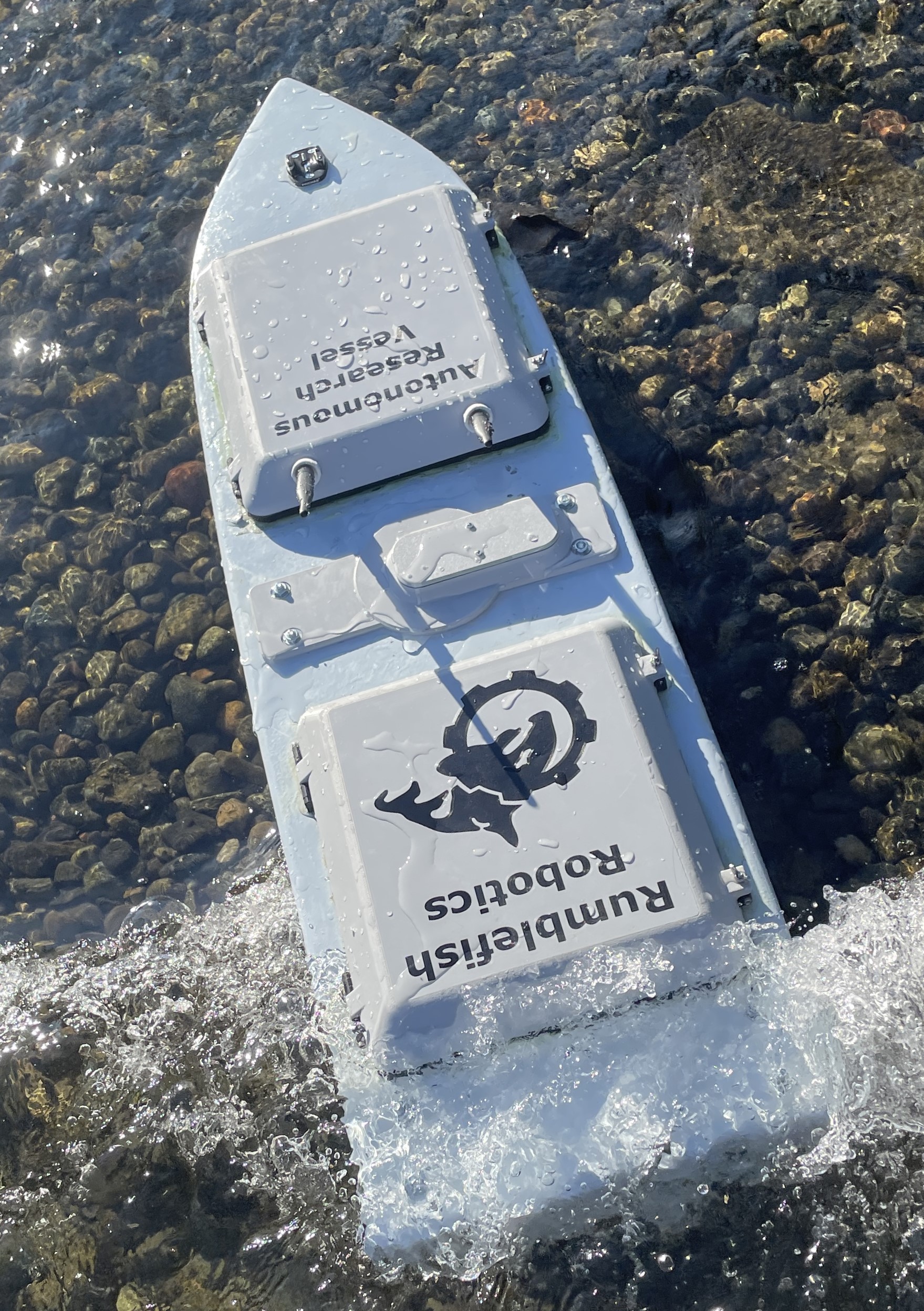
Rumblefish Argo integrated platform navigating shallow rocky shoreline
Dedicated Mission Architecture Available Now

Argo: Integrated Platform

Factory-integrated, seamless hull optimized for maximum acoustic quietness, dedicated missions, and the absolute shallowest draft envelope.

  • Integration Architecture Dedicated Factory-Integrated Payload
  • Length Overall (LOA) 1.4 m (4.6 ft)
  • Static Draft 11 cm (4.3 in)
  • Minimum Operating Depth 18 cm (7.1 in)
  • Optimal Survey Speed 1.0 m/s (1.9 kts)
  • Max Survey Speed 1.2 m/s (2.3 kts)
  • Deployment Logistics 1 Person • < 2 min cycle
  • Primary Operational Role Dedicated Missions & Acoustic Pickets
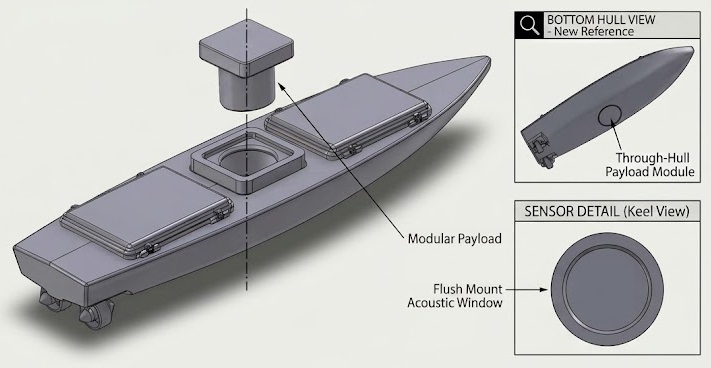
Rumblefish Delia field-reconfigurable modular payload bay diagram
Modular Mission Architecture In Development

Delia: Field-Reconfigurable

Expanded displacement hull with a quick-latch through-hull payload well and sealed deck access bays, enabling multi-role mission reconfigurations directly in the field.

  • Integration Architecture Quick-Latch Modular Bay (Through-Hull)
  • Length Overall (LOA) 1.4 m (4.6 ft)
  • Static Draft 14 cm (5.5 in)
  • Minimum Operating Depth 20 cm (7.9 in)
  • Optimal Survey Speed 1.0 m/s (1.9 kts)
  • Max Survey Speed 1.9 m/s (3.7 kts)
  • Deployment Logistics 1 Person • < 2 min cycle
  • Primary Operational Role Multi-Role Operations & Swappable Payloads

Environmental Limits & Seakeeping Envelope

Built for demanding littoral missions near shore, in rivers, and across inland lakes, the platforms are designed against established Sea State thresholds. Their operational envelope extends comfortably to ocean environments—including open sounds, tidal straits, and passages between island chains.

Sea State 0 – 2
Fully Mission-Ready
Calm to smooth seas (waves < 0.5 m). Complete operational envelope for any integrated or modular payload profile: bathymetric mapping, acoustic monitoring, and sensor logging. Centimeter-level spatial precision when running with active RTK GNSS.
Sea State 3
Autonomous Navigation & Position Hold
Slight seas (waves 0.5 m – 1.25 m). Maintains corridor waypoint tracking, virtual anchor position hold, and automated Return-to-Launch (RTL) navigation.
Sea State 4
Platform Survivability
Moderate seas (waves 1.25 m – 2.5 m). Hull watertight integrity and positive buoyancy maintained; propulsion enters passive station-drift to preserve platform safety until recovery.

Operational & Engineering Capabilities

Explore detailed platform engineering, propulsion architecture, and deployment logistics. Click any category to expand specifications.

Propulsion Architecture Rudderless Differential Vectoring & Debris Mitigation
+

Solid-state differential vectoring eliminates mechanical linkages, steering arms, and vulnerable through-hull shaft seals that bind or fail in gravel shoals and heavy weed lines. For operating in extreme shallow-water environments with severe organic fouling or debris hazards, optional protective intake mesh screens and anti-fouling prop configurations are available.

Autonomous Systems Resilient Autonomy in Degraded Environments
+

The onboard autonomy engine enables missions to persist even when critical subsystems—including GPS/GNSS or command-and-control RF links—are jammed or degraded. Operators can configure deterministic failsafe behaviors, including dead-reckoning mission completion, contingent loiters, silent drift holds, or covert return-to-base corridors executed without active broadcast chatter.

Field Logistics Field-Secure Rapid Turnaround (< 6 Min Swap)
+

Engineered for continuous operational tempo, the power bay features a robust four-bolt lockdown that delivers watertight sealing and shock absorption in heavy chop while remaining fast to service. A complete operational cycle—recovering the craft, executing full field maintenance with a fresh battery swap, and redeploying into the water—is accomplished in under 6 minutes.

Mobility & Handling Zero-Infrastructure Transport & Deployment
+

The compact 1.4-meter hull is engineered to fit comfortably inside standard pickup truck beds, commercial cargo vans, or SUV interiors. The platform operates entirely free of secondary support equipment—requiring no cranes, davits, trailers, boat ramps, or dedicated support vessels for transport or deployment.

Deployment Readiness Expeditionary Global Logistics & Air Transport
+

Standard vehicle deliveries ship fully turnkey with our high-density battery packs included. However, for escalated emergency responses and urgent operational deployments, the vessels are engineered around widely available marine battery form factors. This architecture enables the unpowered platform to be air-transported immediately—including as checked airline luggage or fast commercial air cargo—bypassing the hazardous freight delays inherent to large lithium battery logistics. Teams can source compatible marine batteries locally upon arrival and launch within hours, avoiding slow specialized ground shipping.

Bespoke Engineering Direct-Build Custom Hull & Mission Integration
+

While our field-reconfigurable platform accommodates a wide variety of sensor pods via modular bays, our dedicated-mission hulls are built to order. When your mission profile requires integration beyond modular bays, this direct-build model allows our engineering team to collaborate directly with you—integrating custom below-water mounting geometry, specialized transducers, and bespoke structural hardware straight into your delivered hull.